



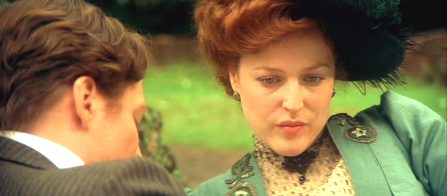
Terence Davies adapts Edith Wharton’s novel about the price of trying to fit in to wealthy New York society in the early 20th century.
The English filmmaker Terence Davies died two years ago at the age of 78. He’s a director I always admired, and an artist that I think has gone underappreciated by general audiences. One of the films I wish more people knew about is his adaptation, from 2000, of Edith Wharton’s great novel The House of Mirth. Rather than using the material as a vehicle for his own concerns, or creating “entertainment” through the distancing effect of dramatic spectacle, Davies directed all of his energy toward faithfully translating the sensibility of the book itself. That The House of Mirth succeeds as a film is due, then, as much to Wharton herself as to her interpreter. It also means, however, that the film refuses to hold our hand and explain everything in a way that will prevent us from being involved or implicated in its truth.
Lily Bart, an orphan taken under the wing of her rich aunt, has made a sparkling entrance into the wealthy New York society of 1905. She is, unfortunately, not very well schooled in the rules of upper class behavior. She’s expected, as a necessary part of fitting in with this circle, to play bridge with them at their big parties in the city or on their Long Island estates, but she loses more money than she can afford to at these games. Her position is complicated by the fact that she is in her late twenties and still unmarried—unusual at that time—so it is therefore essential that she find a suitable husband, preferably a rich one. The trouble is, Lily, despite a streak of selfish carelessness, has a fineness of spirit, a conscience, and a need for real love, all of which conflict with the mercenary role she is expected to play.
Gillian Anderson stars as Lily, our main character. Her performance is a brave one: first showing us the character’s elaborate mask, and then gradually letting the mask fall, until we finally witness an intense vulnerability and sorrow that is heartrending.
Eric Stoltz, an actor I don’t normally associate with civilized refinement, plays Lawrence Selden, the lawyer and confirmed bachelor who has the only true affection and affinity for Lily. Although he associates with the wealthy, he is not wealthy himself, and this apparently excludes him from consideration as a husband for her. Stoltz plays Selden with a light tenderness and charm that only partly conceals an essential diffidence. The tragedy is that the forms of communication Selden and Lily are constrained to use with each other prevent them from ever fully expressing their true feelings. The bitter irony of Selden’s story, which I think Stoltz conveys perfectly, is that he assumes a superior air towards the prevailing ethos of wealth and the idea of marrying money, while in fact his assumptions, and his lack of decision, are determined far more by this ethos than those of the seemingly less principled Lily.
Wharton knew that rich men could do as they pleased, while enforcing the strictest and most unforgiving moral code on women.
The House of Mirth is film of subtlety and intelligence and visual poetry, a criticism of life in the guise of a social tragedy. It has inner integrity, beauty, and an astonishing central performance from Gillian Anderson. It should be praised and celebrated, which is what I’m doing right now.