


Two young fishermen take a job on a boat that has returned after disappearing for thirty years, in a film about the tragic paradoxes of time and mortality.
In a mosaic of very brief shots—fragments really—we are shown an old stone and concrete quay above the seaside on a rainy day. A stout middle aged man sees a small boat in the dock below. There is no one on it. As he climbs in, there are close-ups of his face, his feet, the mottled surface of the stones, and a curious old name plate that says “Rose of Nevada.”
Rose of Nevada is the name of the film, which is odd because it takes place in a fishing village in Cornwall, on the southwest tip of England. One doesn’t associate Nevada with ships or the sea, but it’s only one of many weird details in this movie, written and directed by Mark Jenkin, himself a native of Cornwall. Everything seems strange—and Jenkin doesn’t explain very much. We are made to assemble the pieces of this puzzle through enigmatic utterances and clues. “It’s come back,” the stout man Mike tells a friend, and we’re left to wonder how or why an unmanned boat would somehow “come back” on its own. And from where? And when?
A protagonist emerges: Nick, played by George McKay with an expression of continual astonishment. He struggles to support a wife and young daughter in the village. As the rainstorm gets worse, he goes up on his roof to try to fix a leak, and ends up falling through the ceiling into the kitchen. It’s funny, but Jenkin’s style continues to maintain a feeling of dread and melancholy throughout.
We then meet another character, Liam, a young man played by Callum Turner, whom we see having a pint at the local bar and flirting with a young woman. She’s one of the two daughters of Tina, a sad local widow played by Rosalind Eleazar. Gradually we learn that Tina’s husband went out on a fishing run on the Rose of Nevada years ago, and never returned.
An old couple living next door to Nick are mournful as well—the woman seems to have succumbed to dementia, and we see the man leaving roses on the edge of a cliff and wavering over the great drop to the sea rocks below. Someone close to them must have jumped off there.
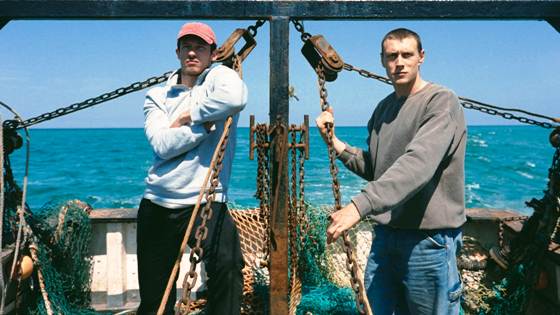
Meanwhile, a bearded weather-beaten skipper, played by Francis Magee, emerges mysteriously from the cabin of the fishing boat. He tells the owner, Mike, he needs two hands to do fishing runs. Mike announces it in the village—first Liam and then Nick volunteer to go. When Nick arrives at his quarters on the boat, he sees scratched into the wood of his bunk the words “Get off this boat now.” He doesn’t, of course, and we then enter the realm of the sea fishing trade, with the three men letting down the net by cables again and again, then bringing up and gutting the many fish they catch.
Jenkin shot the picture on grainy 16-millimeter film, with occasional overexposure, to give the movie a strange antiquated look. He’s fascinated by the colors and other visual details of objects: the rusty anchor, the cables, the seamen’s boots. The style creates a cold dreamlike feeling which is meant to evoke the losses and griefs of the village, and the fishing scenes take on an almost punishing feeling of exhausting labor.
The description of the movie in reviews and online give away what happens next. I won’t do that. All I will say is that when the boat returns, the two young men encounter a dreadful paradox of time, death, and identity. The audience must put the clues together by listening carefully to what the people are saying, and the different ways the two men respond. Jenkin uses folkloric themes about the sea to inspire a dark sense of hauntedness. Rose of Nevada takes us on an eerie, unsettling journey into the mysteries of the heart.