


How to explain my affection for the least typical of all Universal horror films, 1934’s The Black Cat, directed by Edgar G. Ulmer? It won’t be easy, because by most conventional measures concerning story, dialogue, or even just plain scariness, The Black Cat would usually be judged absurd, a failure, even a bad film. But it has a unique quality that fascinates me, a near abstract style through which we can hear a faint, sad, poetic melody.
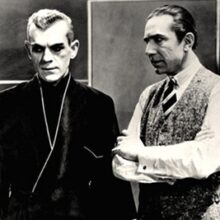
Edgar Ulmer was an Austrian Jewish émigré who came to the U.S. as an assistant to F.W. Murnau, one of cinema’s all-time greatest directors. From the master he inherited a love of the slow tracking shot, and the innovative use of screen space and lighting for emotional effect. He was a true independent, working for small producers on the margins of the industry, all his life having to work within tiny budgets making B-films. The Black Cat was the only film he directed for a major Hollywood studio. Universal wanted to capitalize on the success of Dracula and Frankenstein by putting the two stars, Bela Lugosi and Boris Karloff in their first movie together. Nevertheless, it was a low-budget production by Hollywood standards.
The opening credits say, “Suggested by the Edgar Allan Poe story,” and that’s nonsense. This film has nothing whatsoever to do with the Poe story. There is a black cat in the film, and Lugosi’s character has a phobia of cats, but it’s pretty meaningless and I suspect the cat was put in there so they could use the title.
Lugosi plays an Austrian doctor, recently released from prison, who seeks revenge against a mad former officer and engineer played by Karloff, who stole the doctor’s wife and seduced his daughter. Karloff’s character has built a futuristic castle in Hungary, on the ruins of a fort he betrayed to the enemy during World War I. Into this situation stumbles a pair of American newlyweds played by David Manners and Jacqueline Wells. Karloff’s character, wearing a bizarre triangular haircut and a uniform that looks a little like a bathrobe, decides to sacrifice the young wife in a Satanic ritual.
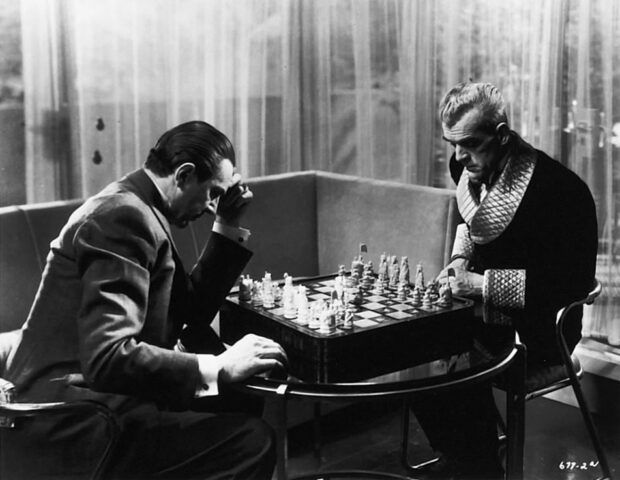
Once we’re in the castle, the characters move in weirdly regimented fashion, striking poses to an overbearing classical music soundtrack. Karloff challenges Lugosi to a game of chess, warning him however that he “always wins.” In some mysterious way they’re playing for the life of the young woman.
Well, the nonsensical plot can inspire laughter, especially if you’re watching the film with others. But the motifs that Ulmer introduces, practically unmoored from what we usually think of as context, were shocking in their day, and perhaps we’re not as shocked only because we’re watching it eighty years later. Audiences must have been startled seeing Karloff roam the dark halls of his castle, in which at different points are situated glass cases containing the bodies of women he has murdered, all while the haunting 2nd movement of Beethoven’s 7th Symphony plays on the soundtrack.
Strangely, the characters seem motivated by forces outside of the script, as if they symbolized taboos to be broken. Satanism, necrophilia, torture, incest, even drug addiction gets hinted at here, which is all very heavy stuff for 1934, although sadly not so much for us. Plus: Bela Lugosi plays the good guy for once. Sort of.
I was tempted to call The Black Cat one of my guilty pleasures, but on reflection I have to say—I don’t feel guilty at all.