


A young woman oppressed by her controlling mother discovers her own strength when she is encouraged by a psychiatrist to go out into the world.
In 1942, Bette Davis was Warner Brothers’ biggest star. She’d attained this status not through conventional beauty, but through her talent, hard work, and incredible dramatic range. Her filmography up to that time is basically a list of classics. And now at the height of her career, having already won two Best Actress Oscars, and four other nominations, she starred in one of the great romantic films of the era: Now, Voyager.
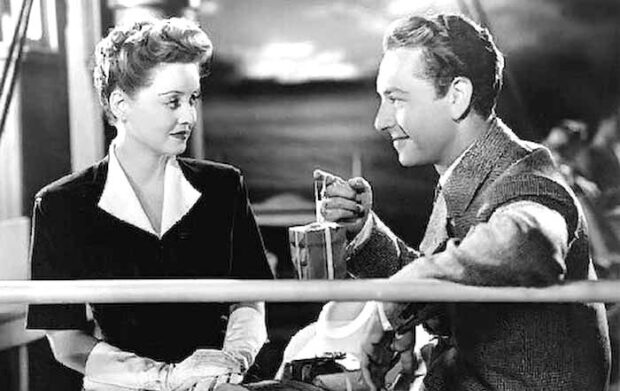
She plays Charlotte Vale, a neurotic, repressed young woman, who lives with her mean, brutally dominating mother, played by Gladys Cooper, and is almost suffocating with loneliness. Painfully shy and cowering before her mother’s abuse, she appears to be on the verge of a nervous breakdown when her sister-in-law suggests that she see a psychiatrist, Dr. Jaquith, played by Claude Rains. The wise doctor has her stay in his sanitarium for a while, eventually suggesting that she go on a luxury cruise to Europe. On the ship she has difficulty mixing in with the passengers, but circumstances find her spending some time with a sophisticated gentleman named Jerry Durrance, and played by Paul Henreid, fresh off his famous supporting role in Casablanca earlier the same year. Charlotte and Jerry fall in love, but as it turns out, he is married, albeit unhappily.
Now, Voyager was adapted by one of Hollywood’s finest screenwriters, Casey Robinson, from a novel by Olive Higgins Prouty. The title is from a line in a Walt Whitman poem: “Now, voyager, sail thou forth, to seek and find.” Prouty drew on her own beneficial experience of psychiatric treatment, and the core of the story is of a woman discovering herself and breaking free from the constrictions of her upbringing.
The director Irving Rapper balances sentimentality and romanticism (aided by one of Max Steiner’s lush musical scores) with a fresh, humanistic point of view. Doctor Jaquith sees through the empty moralism of Mrs. Vale, and later in the film, Charlotte successfully stands her ground against her mother in a way that seems both satisfying and real. The film affirms the right of the child to be free of the parent, just as it also envisions a woman who can love a married man without guilt.
In a rather unlikely turn of events, Charlotte becomes a sort of surrogate mother to Jerry’s unhappy teenage daughter. Although these scenes are somewhat awkward, the point is consistent with the rest of the movie: a mother can support a girl in being herself rather than trying to rule over her with phony ideas of propriety.
Now, Voyager is famous for Henreid lighting two cigarettes and then handing one to Davis, which was considered terribly romantic and now seems silly. But it’s Bette Davis that makes the film truly memorable. She gives a measured, carefully controlled performance, with many subtle shades and touches rounding out the character. In some ways, it’s the essential Davis role, portraying a journey from despair to love and dignity. In the perfect final scene of Now, Voyager, she says, “Don’t let’s ask for the moon, we have the stars.”