


A documentary details the murder trial of a landowner accused of killing an indigenous villager in Argentina, illuminating the long history of exploitation of native people in that country.
Argentine writer-director Lucrecia Martel has long been exploring her country’s social tensions and contradictions in her dramatic films. Now in her latest film, she’s turned to documentary, in a project it’s taken her almost a decade to complete: Nuestra Tierra, Our Land.
Just as in her fictional works, Our Land plunges us into its subject without explanation, and with no narrative voice, letting us figure out what’s going on by ourselves. A courtroom trial is beginning, and we see and hear from the three accused, a landowner and mining entrepreneur named Darío Luis Amín and two of his associates, former police officers, who’ve been charged with murder and attempted murder. Amín testifies that he drove onto land that he owned by legal right in order to claim a stone quarry that he needed for the development of a mine there, but was surrounded by people claiming to be indigenous inhabitants of the area who aggressively confronted him and told him to leave, making him feel threatened enough to pull a gun which he fired nine times, killing a 68-year-old man, Javier Chocobar and wounding others.
One of his assistants filmed the encounter, and the grainy footage is screened in the court. The content of the film calls into question the defendants’ version of events. Gradually we learn more background. The incident occurred nine years earlier, in 2009, and it has taken until 2018 to finally come to a trial. It happened in the Choromoro Valley in Tucumán Province, a sparsely populated mountainous region in northwest Argentina. We see the witnesses reconstructing the details of the shooting from memory on the site of the event. Here Martel displays a method that is new for her—the extensive use of overhead moving shots using drones. This technique becomes more and more prominent as the film goes on, with roving aerial footage of the beautiful rugged land and its tree-covered hills.
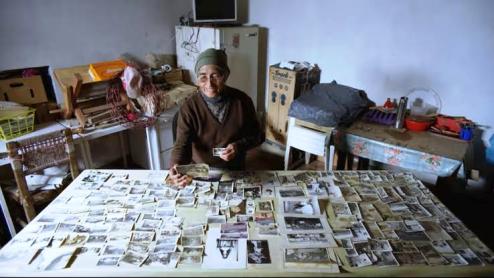
The native inhabitants of this area are the Chuschagasta, or the Chuscha for short, and as the trial proceeds, Martel takes the time to refocus our attention on these people and their history. We see old photographs, with narration by Chuscha elders, showing their lives as experienced for many decades in these villages. Chocobar’s wife shows pictures of him as a young man when they met and eventually married. These accounts keep going deeper until we get a sense of Chuscha history.
For centuries, the Spanish colonial powers stole native land and tried to erase the people’s identity. Many of them didn’t even realize they were indigenous until circumstances forced them to learn. They’ve established a paper trail going back for years: of filings, claims, and petitions about their rights to their home that have been ignored by the government. Indeed, the defense in the trial insists that the Chuscha has been extinct for over two hundred years, and that these people are just hooligans pretending to be indigenous. Thus a film that is framed by the occasion of a murder trial becomes a testimony on the plight of native people, sometimes labeled derisively as “Indians,” in the long history of Argentina since the conquest.
Martel’s evocative style creates a moving portrait of these poor farmers and sheep herders. We are confronted with the question of who owns the land—the people who live and walk on it, or someone with a piece of paper claiming it. Our Land powerfully advocates for the rights of native people.