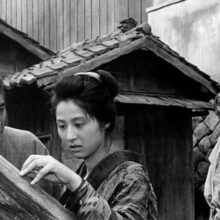



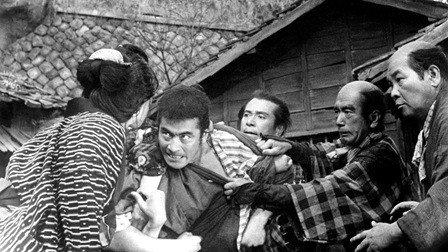
Akira Kurosawa adapted the famous play by Maxim Gorky about a group of outcasts typifying social conflict into a film of remarkable power.
It had long been a dream of the director Akira Kurosawa to make a film adapting the great Maxim Gorky play “The Lower Depths” about the struggles of a group of destitute people living in a flophouse. It had been done before several times by other directors, but Kurosawa felt a strong connection with Russian literature. He’d already done a version of Dostoevsky’s “The Idiot,” and another of his films was inspired loosely by Tolstoy’s “The Death of Ivan Ilych.” Gorky’s play was written in 1902, in the turbulent period before revolution, and it grimly portrayed and satirized the state of society at the time. In 1957, Kurosawa completed his film, The Lower Depths, transposing the time and setting to Japan in the late Edo period, during the 19th century when the Shogunate was collapsing, but the film’s theme, linking poverty with hatred and spiritual despair, is a universal one.
A group of social rejects, including a gambler, an actor, a thief, an ex-samurai, a prostitute, a tinker and his dying wife, quarrel with each other while uniting in their fear and hatred of the corrupt landlord (Ganjiro Nakamura) whose wife (Isuzu Yamada) is meanwhile having an affair with the thief, who is played by Kurosawa favorite Toshirō Mifune. The thief, however, is in love with the landlady’s sister (Kyoko Kagawa), and this causes a great deal of trouble. Into this unhappy situation wanders a mysterious old man played by Bokuzen Hidari who dispenses a variety of spiritual advice that is met with different responses from the others.
Remarkably faithful to the play, the picture has the usual static quality of filmed drama – the inventive camera work can’t wholly compensate for the fact that most of the action takes place in one large room. Nevertheless, it retains much of the power of the original, and Kurosawa accentuates the humorous elements to give the story even greater force.
Mifune’s performance – gruff, comic, vulgar, yet somehow touching – is the film’s best. A most intriguing element – in play and film – is the character of the wandering old pilgrim, who with his marvelous enigmatic smile, brings out the irony in Gorky’s conception. The old man represents religion in both its positive and negative aspects. He offers a much needed sense of hope to the hopeless, and he is one of the few characters to demonstrate kindness. But he also sugarcoats reality with consoling lies, and offers a passive attitude of escape from life rather than engagement with it.
Kamatari Fujiwara, playing an actor who can’t stop drinking, drawls his words out to such absurd effect that I laughed out loud, even though I don’t speak Japanese. A card game scene features an incredibly silly, rhythmic sing-song number, led by Koji Mitsui as the gambler, that is reiterated to great effect at the movie’s shattering climax, with the characters dancing to weird music while reciting nonsense syllables. Rarely has comedy and tragedy been combined so well in a single scene.
With its theatrical nature, The Lower Depths is uncharacteristic of most of Kurosawa’s work. It succeeds, though, and I think it deserves to be better known, both on its own terms and as the best film interpretation of the powerful Russian play.