


U.S. early 20th century history is the context of this story of a hard-working logger in the northwest who has high hopes but must endure great loss.
Train Dreams is an historical drama taking place in the forests of the northwest United States during the early 20th century. You might think that the story has to do with trains, and a small part of it does, but the title really symbolizes the painful creation of the modern world in America, born from the sweat and toil of poor working people just trying to survive. The film is directed by Clint Bentley and co-adapted with Greg Kwedar from a book by the late acclaimed writer Denis Johnson.
Joel Edgerton plays Robert Grainier, a quiet man who was adopted by a family in northern Idaho when he was seven, an orphan with no memory of how he became one. At a general store in his town, in an event foreshadowing later troubles, the boy witnesses a Chinese family being chased out during a street riot against Chinese residents. It’s not mentioned in the film, but there was a long government campaign of exclusion and deportation against Chinese living in the U.S., after Chinese immigrants had already played a key role in the construction of the Central Pacific Railroad.
Robert meets and falls in love with Gladys Olding, played by Felicity Jones, and they get married and build a cabin near the Moyie River in the Idaho panhandle. He goes to work on the Spokane Railway nearby, under ruthless conditions. One day, with no explanation, a Chinese laborer working in Robert’s crew is grabbed by some men and thrown to his death off a bridge. Robert decides never to work for the railroad again, and he will be haunted by the face of the victim from then on. He takes jobs in seasonal logging, as part of work teams that cut down thousands of trees for the wood and paper industries. Meanwhile Gladys has given birth to a baby girl.
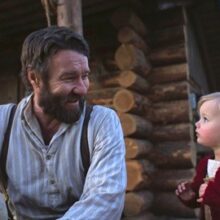
The story has a narrator, Will Patton, which in an adaptation of this novella is needed because so much is told through the thoughts and feelings of the main character. There are quite a few actors in supporting parts, including William H. Macy in an interesting role as one of the older loggers who does some of the odd jobs for the crew. But Train Dreams is really a showcase for Joel Edgerton, the Australian actor who has appeared frequently in film and TV for 25 years now. This, I have to say, is his best performance yet. He portrays a man who loses everything and lives in a state of perpetual mourning. Edgerton’s work is authentic, never showy, conveying the emotions of this grief-stricken character with absolute assurance.
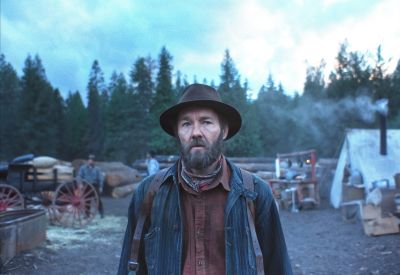
Despite the occasional anachronism or note of sentimentality, this is a fine effort. It’s also very beautiful. Bentley and his cinematographer Adolpho Veloso capture the gorgeous wilderness and its underlying sense of mystery, contrasting with the relentless struggles of the characters. It’s all done with natural light, including the interiors, where we’ll often see a doorway in a darkened house framing the bright splendor of the country outside. Train Dreams is about the tragic paradox of America—it’s a film of profound sadness and revelation.