


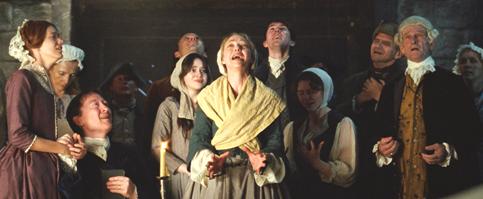
A film about the leader of The Shakers, an 18th century religious group, uses songs and dancing to portray the fervent spiritual forces at work in the nonconformist Christian movement.
We don’t see many film dramas about devoutly religious people—partly, I think, because the main action takes place inside a character, and this is hard to depict on screen. Mona Fastvold faces that challenge head-on in her new film portraying the life of the leading figure in the history of the Shakers: The Testament of Ann Lee.
Amanda Seyfried plays the title role of Ann Lee, a young woman in mid-18th century Manchester, England. She discovers a community of Quakers with which she and other family members join. This group engages in a form of ecstatic dancing where their bodies shake and shudder, and thus the eventual name “The Shakers.” Ann marries a fellow church member and in the course of time she bears four children. Fastvold is intent on showing the brutal nature of life among common people in that period, and in one tragic sequence we witness all four of her births, each more painful and difficult than the last, with the terrible outcome that all four children die before reaching the age of one. This is for her a breaking point.
The film’s unusual method for bringing the audience into the subjective experience of this charismatic group is music and dance. In fact, it’s a musical, really, although not the kind we’re used to from Broadway shows. Daniel Blumberg has fashioned a score, and a series of songs, based on original Shaker spirituals, but with some darker tones of his own. Seyfried and the other actors perform these songs, which are of an exceedingly emotional yet somber and unearthly nature, often during the Shakers’ ecstatic dancing, choreographed by Celia Rowlson-Hall. The dancing is very stylized, I’m sure much more than the dancing of the Shakers at the time actually was. Among the rapturous movements, the dancers thrust their arms towards heaven and down to their chests as an expression of their desire for spiritual ascension and release from the body. The central place of songs in the structure of the movie has the effect of making the objective events seem an expression of a passionate inner experience.
Non-conformist Christian movements surged during the 17th and 18th centuries, and they were persecuted at times, Ann is arrested and refuses to eat while in prison. Weakened by hunger, she sees a vision of the Garden of Eden. After her release, she tells her vision to her close friends in the church, and reveals its meaning: the one sin preventing people from entering paradise is fornication. Their church must practice complete celibacy to be saved. Her listeners kneel to her and call her “Mother Ann.” From then on, she is the leader of the Shakers, and will in time take her followers to America.
Seyfried gives a great, utterly committed performance that carries the film. Fastvold cultivates a sense of uncertainty throughout. We can see how the beliefs are related to sexual trauma, and with our modern eyes we recognize the elements of fanaticism. But the expert cultivation of the Shakers’ point of view draws us in past such judgments. Fastvold doesn’t romanticize any of this—and not offering any comfort to the audience can make The Testament of Ann Lee a harsh and painful journey. We witness an ordeal in which the masks of identity are ripped away, leaving a self-consuming spiritual flame.