



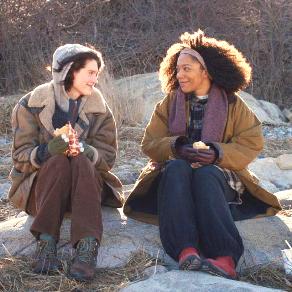
A young woman professor is challenged by the memory of a traumatic event.
Sorry, Baby is the debut feature from 31-year-old Eva Victor, who is the writer, director, and star of this drama about persevering through traumatic events with honesty and humor. Victor plays Agnes, a newly promoted professor at a New England school who is visited by her best friend and former college roommate Lydie, played by Naomi Ackie. Their affectionate ways with each other, their conversations and jokes, convey a genuine rapport. Then Lydie springs a surprise: she’s going to have a baby.
The film is divided into sections, or chapters, each with a title designating “the year of” something, like “the year of questions” or “the year of the sandwich.” The second such chapter flashes back to when Agnes and Lydie were in graduate school. Agnes has completed her thesis, and her advisor, a professor named Mr. Decker, praises its excellence. Their conference is interrupted, and he reschedules it for his on-campus house. Agnes goes there, and then a “bad thing” happens.
I use this euphemism, because even though we hear Agnes describing what happened later to Lydie, the labeling of it is characteristic of Agnes’s wounded reaction to the event. She’s wary of talking about it to anyone except her friend. But it’s a serious drag on her mind and emotions as she tries to reorient herself after Mr. Decker ends up resigning and moving away.
The movie continues jumping back and forth in time, as Agnes navigates through her painful feelings while still making the effort to “show up” in her own life. Sorry, Baby avoids the kind of somber hand-wringing or predictable dramatic reactions and events that have become standard in movies about sexual trauma. Instead the screenplay, and Victor’s intelligent, expressive performance, show how different our experiences are from what we tend to expect. The changing of the “bad thing” from its original immediacy to a part of the story of spiritual survival is reflected in little details of life, like filling out a jury questionnaire, or interacting with a fellow grad student who is jealous of her promotion to professor. The film attains a feeling of just getting through each day with patience, practicing some tenderness towards oneself, and an ability to see the humorous side of things.
Victor has a witty, low-key comfortable style. Lukas Hedges is funny as a neighbor who gets into a romantic relationship with Agnes while still not quite “getting” what she’s about. In the final section, Lydie return visits with her wife and baby, which provides an opportunity for a lovely little scene where we learn the reason for the film’s title.
Now, if you’ve listened to my show for any length of time, you know I have a propensity for talking up big works of art, epic in scope, that tackle major issues of society, politics, and art. I’m aware of this about myself as a critic, but I have to say that I also want and need shorter and more modest films like this about the thoughts and struggles of people in what we call “ordinary” life. Sorry, Baby doesn’t try to be earth-shattering. It just opens a window to a character’s inner world and its expression in her personal environment. It’s smart, subtle, engaging, and well worth your while.