

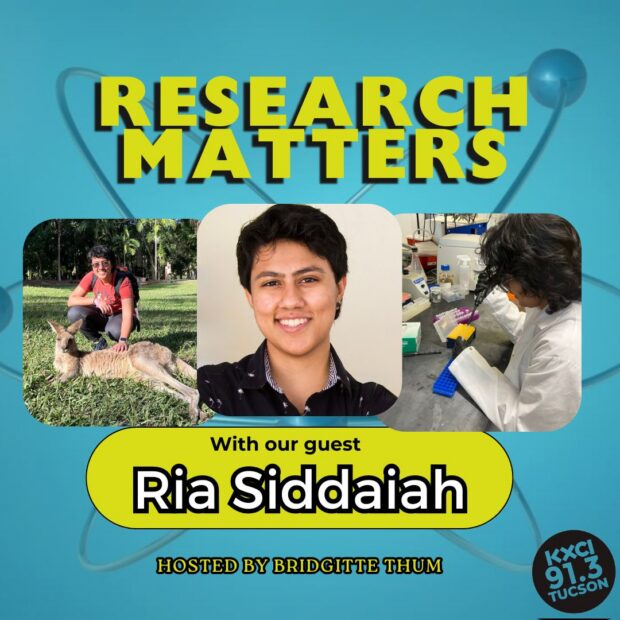
Hello! My name is Ria Siddaiah, and I am a senior at the University of Arizona, majoring in Molecular and Cellular Biology with an emphasis in Genetics and Human Health, and minoring in Biochemistry and Business Administration. I was formerly an undergraduate researcher in the Campos lab, where we studied the infectious mechanisms of Human papillomavirus (HPV), which is responsible for 5% of cancers worldwide, and nearly all cervical cancers. I am also in my first year of the Accelerated Master’s Program in Molecular and Cellular Biology. My graduate research is being conducted in the Charest lab, where I am studying the impact of the small GTPase Ras and its relationship with key molecular players in the progression of metastasis and, potentially, cancer development. When not in the lab, you can find me at the movies, trying new restaurants, or volunteering around town.
Transcript:
0:13: From KXCI Community Radio, this is Research Matters.
0:17: My name is Bridgitte Thum and I have the privilege of getting to chat with academic researchers from all over our region.
0:24: We are joined in the studio today with an accelerated master’s student from the University of Arizona.
0:29: Who is interested in molecular and cellular biology.
0:33: Welcome to the studio, Ria Siddaiah.
0:35: Hi, it’s nice to be here.
0:37: Oh, it’s great to have you.
0:39: Could you tell me a little bit about the work you’re doing in the lab these days?
0:42: I work with Dr. Pascale Charest, and we are looking into the phenomenon of directed cell migration.
0:48: Which is a naturally occurring process and it is normally involved in just moving cells around to different parts of a region or parts of the body depending on what processes require.
0:58: However, directed cell migration gets hijacked to become overactive in cancers.
1:04: And so we’re looking into the mechanisms of how migration works naturally in order to further understand what parts of the system are taken over.
1:11: More specifically, I’m looking into the process of interactions between two proteins called Ras and the mechanistic target of rapamycin complex 2 called mTORC2.
1:22: We know that they are involved in this migration and we know that mTORC2 tends to be overactive in some cancers and in kind of changing parts of this pathway on purpose, we can hopefully understand downstream effects to predict how metastasis is started up in some of these cancers.
1:42: Is Ras like a tour bus?
1:44: Are they going on a world tour?
1:46: Are they like all aboard and then the proteins get on the bus and then they just wreak havoc in every city?
1:51: It’s more like tag, so many proteins, so one, you know, growth factor activates one protein, which activates another protein, which activates Ras, which activates another protein, so on and so forth.
2:00: Domino.
2:01: Yes.
2:02: What we’re predicting is that this overactive Ras causes overactive empty.
2:06: mTORC2, which causes increased migration and potentially cancers, but we can’t know that for sure unless we cause it.
2:13: Yeah, exactly.
2:14: Fill up the Ras with a full tank of gas, and how do you do that?
2:19: You give it its favorite food, like, how do you overactivate the Ras?
2:23: Gene editing mechanisms, most commonly like CRISPR and things like that.
2:27: We changed one of the amino acids in the protein.
2:31: And that makes it capable of doing its job without needing to be activated previously.
2:35: Thank you for the work you’re doing.
2:37: Why do you think this research matters?
2:39: Well, I mean, specifically for cancers, there’s so much unknown.
2:42: Every single type of cancer is different.
2:44: Every single type of cancer has different causes, impacts, and ways to be treated.
2:50: The more we know about the way the cancer works.
2:52: the easier it is to treat in the future.
2:54: You’ve been listening to Research Matters.
2:56: Our guest today is Ria Siddaiah.
2:59: We have been speaking about directed cell migration, studying cancer, and making the world a little bit easier to understand every day in the lab.
3:10: Thank you for the work that you do, Ria.
3:12: Thank you for having me.
3:14: Research Matters is produced in Tucson, Arizona at KXCI Community Radio, which is a listener supported radio station.
3:22: To hear more episodes, visit KXCI.org.
3:26: Thank you.