

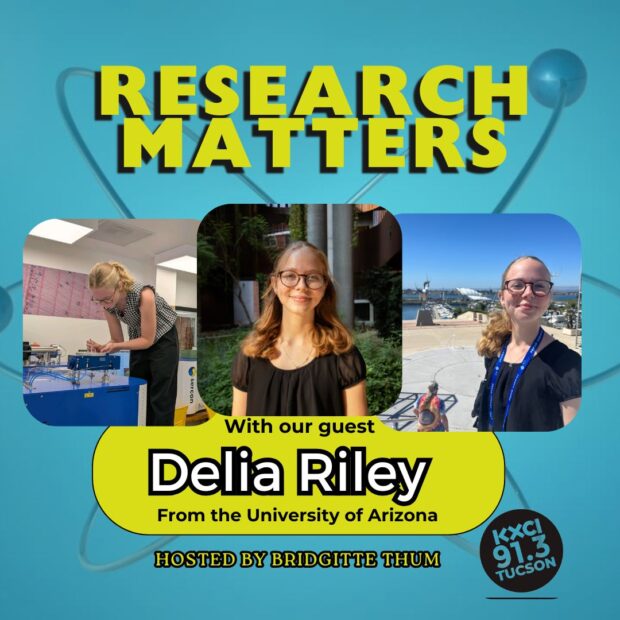
My name is Delia Riley, and I am a sophomore at the University of Arizona. I am majoring in Geosciences
and Mathematics, with minors in Chemistry and Spanish. I also work with Dr. Soumaya Belmecheri and Dr.
Bryan Black in the TIME (Tree Ring Innovations in Mass Spectrometry for Earth Systems) Lab at the
Laboratory of Tree-Ring Research. My current focus is in developing the best method to measure carbon
and oxygen isotopes using pyrolysis. With accurate carbon and oxygen isotope data we are better able to
understand climate history and earth hazards. When I’m not in class or in the lab, I enjoy hiking, reading,
baking, and spending time with the people I love.
Transcript:
0:01: This is Research Matters from KXCI Community Radio.
0:04: My name is Bridgitte Thum, and I’m joined in the studio today with a sophomore from the University of Arizona, Delia Riley.
0:12: Welcome to Research Matters, Delia.
0:14: Thanks so much for having me.
0:15: So what are you majoring in?
0:17: I’m majoring in geosciences and mathematics, and I’m also doing minors in chemistry and Spanish.
0:23: Are you doing any lab work?
0:24: I am.
0:25: I work in the laboratory of Tree Ring Research.
0:28: What?
0:29: Yeah.
0:29: Tell me all about it.
0:31: so we use tree rings.
0:33: Obviously, trees grow rings annually.
0:36: So, we can look at their width to tell things about the climate, like how much it rained that year.
0:44: so we can just like take a picture of a tree and go year by year and see how it was.
0:49: Impacted by different climatic factors, but then we also use things like clams because they also grow annular rings, which is super fun.
0:57: That’s the project I worked on over the summer.
0:59: So clams and trees, they have a lot more in common than we thought.
1:02: Yes, they do.
1:03: so do like parts of fish.
1:05: They also grow annular rings.
1:06: There are tons of things that do it all the time.
1:09: And we can also do different things like by dissecting the trees into their.
1:13: rings so we can look at like the oxygen isotopes in them and see like directly how impacted they were by things like precipitation.
1:22: So you’re able to basically look at their personal history.
1:25: Exactly, yeah, exactly how the tree grew up.
1:28: Were there any surprises that you encountered during this research?
1:31: Definitely.
1:31: One of my favorite things that I’ve done so far is date a clam like back to like Before Christ, like, so we’re able to see like sea surface temperature in the North Pacific.
1:43: That’s what we measure with the clams, that’s like their proxy.
1:47: They can go back really far.
1:48: They’re just sitting on the bottom of the ocean and like all of a sudden you’ll be holding it one day and then measuring it the next, and you can see like where it falls into chronology.
1:57: that we’ve already made.
1:59: And so it was kind of awesome to see something that was sitting on the floor of the ocean that long ago.
2:04: I’m picturing this is like some kind of like really high tech pattern recognition and you’re basically like lining it up with other timelines from other research.
2:13: Yeah, the pattern recognition isn’t so high tech.
2:15: We do like place dots every, for every year and then the computer can measure it based on like how big the picture is that we give it.
2:23: But you’re able to place that in a point in time.
2:26: Yes, if we’re doing trees, you can take cores from live trees.
2:29: So, we know what year it is.
2:30: We can go back in time through that, but then with dead trees, we’re able to match up the ends, so you can kind of just create this like super far back chronology to see how all the trees.
2:42: Connect and see like their different patterns.
2:44: Because every year truly is different and then it comes in different waves and cycles.
2:48: What is the practical application of knowing a tree’s personal history or a clam for that matter?
2:54: We’re able to use them as proxies for things like temperature and precipitation.
2:59: We can use mass spectrometry, so we’re able to like really accurately tell different things about the climate.
3:05: It which if we know about the past and we know what was going on, we’re able to predict the future from there.
3:11: It’s kind of poetic to think about by analyzing and understanding the past, you can kind of forecast the future a little bit, definitely to know what would be a reasonable thing to expect.
3:23: Yes, it’s a super useful tool.
3:25: We’ve been talking with Delia Reilly uncovering secrets from the past.
3:29: As we look towards the mysterious future.
3:32: Well, thank you so much for coming to Research Matters.
3:34: Thank you so much for having me.
3:36: Research Matters is produced in Tucson, Arizona at KXCI Community Radio, which is a listener-supported radio station.
3:44: To hear more episodes, visit KXCI.org.
3:48: Thank you.
____________________________________________
This program is hosted, recorded, edited, and produced by Bridgitte Thum
Special thanks to UBRP and Quinn Reilly for all the support and community connections.