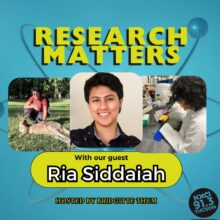


Hello! My name is Ria Siddaiah, and I am a senior at the University of Arizona, majoring in Molecular and Cellular Biology with an emphasis in Genetics and Human Health, and minoring in Biochemistry and Business Administration. I was formerly an undergraduate researcher in the Campos lab, where we studied the infectious mechanisms of Human papillomavirus (HPV), which is responsible for 5% of cancers worldwide, and nearly all cervical cancers. I am also in my first year of the Accelerated Master’s Program in Molecular and Cellular Biology. My graduate research is being conducted in the Charest lab, where I am studying the impact of the small GTPase Ras and its relationship with key molecular players in the progression of metastasis and, potentially, cancer development. When not in the lab, you can find me at the movies, trying new restaurants, or volunteering around town.
Transcript:
0:03: This is Research Matters from KXCI Community Radio.
0:06: My name is Bridgitte Thum, and I’m excited to welcome back Ria Siddaiah to KXCI to talk about yet another lab.
0:14: Welcome back to Research Matters.
0:16: Tell us more about the labs that you’ve been working in.
0:19: We worked specifically with human papillomaviruses or HPVs with Doctor Sam Campos’s lab in immunobiology.
0:26: HPVs are responsible for about 5% of all cancers worldwide and pretty much all cervical cancers.
0:32: So it is a pretty big deal.
0:33: While there are vaccines on the market, it is still important to understand how the virus works because the exact infectious mechanism isn’t entirely understood.
0:42: What we looked at specifically was a protein called L2, a minor protein that’s responsible for carrying the viral genome partway into the cell.
0:52: HPVs are known as DNA viruses, so they need to reach the nucleus in order to successfully divide, and that division is what we consider infection.
1:02: Our work specifically looks at how this protein L2 carries the viral genome downstream towards the Golgi body.
1:10: These are just parts of this big system that gets the genome from the cell membrane to the nucleus.
1:17: When it gets taken up by the cell membrane, it forms this little capsule, which we call the endosome.
1:23: And we’re looking specifically at how it gets out of that endosome because it needs to get eventually to the nucleus.
1:30: The endosome is the capsule, yes, so it’s like it’s a little vehicle, pretty much, it’s, it’s like a bubble, and you want to know how it gets out of the bubble.
1:37: It carries it just a little bit into the cell and then eventually passes it to the Golgi body and then to a bunch of other organelles before the nucleus.
1:45: This is an epic tale.
1:46: One does not simply walk into the nucleus, right?
1:50: We do need to understand how the viruses actually get to the nucleus.
1:54: There is potential to maybe disprove the currently accepted model.
1:59: We’ve noticed that when you alter certain physical properties of this L2 protein, It doesn’t actually follow these infectious patterns that we’ve recognized in the past.
2:10: We changed these proteins by adding tags to them.
2:13: We used this really big heavy tag because we wanted to kind of weigh down the end of this protein.
2:18: These altered proteins are still somehow accomplishing infection at significantly reduced rates.
2:24: Something has to change or something has to be added to our currently accepted model to basically explain why it’s still able to accomplish infection.
2:33: Because in the past, we believed that the protein had to do some movement through that membrane and this tag is preventing it from doing that.
2:40: So, it’s almost like you took the wheels off the car and it’s still getting to the destination.
2:46: Yeah, but at half speed.
2:48: Something’s happening and we don’t know what, so further experimentation we’ll have to.
2:53: You were able to slow it down.
2:55: In doing so, discovered something entirely out of the left field.
2:59: It’s like if you take the wheels off the car and the car still goes where it’s going, but slower, you’re like, did it need wheels in the first place?
3:06: How did it actually get there?
3:07: Is it actually a sailboat?
3:09: What is the application of this research.
3:12: HPVs are individually responsible for so many, you know, diseases, especially cancers across the world.
3:18: Additionally, DNA viruses and the way that they infect cells, they expand past just HPVs.
3:24: So in understanding the way that this one virus infects the cell.
3:27: Maybe you know we can apply it to other viruses in the way that they in fact tell us as well.
3:31: You’re listening to Research Matters.
3:33: We’ve been speaking with Ria Siddaiah about the intricacies of HPV’s infective mechanism.
3:39: Rhea Sadaya, thank you so much for coming back to KXCI to tell us even more.
3:44: Thank you for having me again.
3:47: Research Matters is produced in Tucson, Arizona at KXCI Community Radio, which is a listener-supported radio station.
3:55: To hear more episodes, visit KXCI.org.
3:58: Thank you.