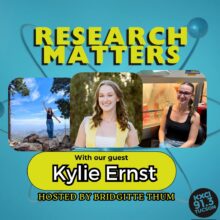


Hi everyone! My name is Kylie Ernst and I’m from Phoenix, Arizona. I am a senior majoring in biochemistry with a minor in French. I’ve always loved science, and I was lucky enough to be able to join Dr. Andrew Paek’s lab during spring of my freshman year. I love my research, which has to do with how breast cancer cells “decide” to live or die under different conditions. I specifically focus on how the activation patterns of different proteins change when hydrogen peroxide reacts with iron in the cell. This fall, I will be studying abroad in Aix-en-Provence, in the south of France. After I graduate, I plan on earning my PhD to pursue a career in cancer biology research.
Transcript:
0:02: This is Research Matters, a program from KXCI Tucson.
0:06: My name is Bridgitte Thum, and I’m joined in the studio with rising senior Kylie Ernst from the University of Arizona.
0:11: How are you doing, Kylie?
0:12: I’m good.
0:12: How are you?
0:13: I’m doing OK, thanks for asking.
0:15: Are you working in any labs?
0:17: Yeah, I work in a lab on campus in the molecular and cellular biology department.
0:22: My PI is Dr.
0:23: Andrew Pike.
0:24: We’re the cell signaling lab, so we look at how breast cancer cells specifically communicate with one another and
0:31: Signals from their environment about what kind of stressors they’re in and looking at how the reaction between iron and hydrogen peroxide in cells affects how these cells decide to live or die in these sort of stressful situations.
0:45: When hydrogen peroxide reacts with iron, it creates a molecule that is really reactive and can be really damaging to a lot of cellular components.
0:53: If there’s a lot of it, it can actually lead to cell death.
0:55: So what are you observing?
0:57: I’m kind of looking at how a bunch of other proteins are
1:01: in what’s happening with hydrogen peroxide and iron.
1:04: Two of the proteins that we’re most interested in, one of them is called P53.
1:08: What that does is it’ll help turn on different genes and kind of make sure that before a cell divides that everything is like OK and healthy.
1:16: But the thing about P53 is that it’s actually mutated in half of all cancers.
1:21: We’re looking at how P53 activation dynamics kind of change with this reaction between hydrogen peroxide and iron.
1:29: And so with those
1:30: higher amounts of hydrogen peroxide that we add to the cells, we see P53 kind of active for longer, whereas when you have low amounts of hydrogen peroxide in the cell, then P53 is active and making sure that cells aren’t dividing with a bunch of crazy mutations.
1:47: But then if you have higher amounts of hydrogen peroxide, then P53 actually gets shut off.
1:52: What’s interesting about that is that the other protein that we’re really interested in, it’s called FOXA1, and that also is helping the cell make Life or death decisions based on the stressors in its environment, but FOXO1 and P53 actually have mutually exclusive activation in the presence of hydrogen peroxide.
2:09: We said that P53 is active at low amounts and inactive at high amounts of hydrogen peroxide, but FOXO1 is shut off at low amounts and then it becomes active at those higher amounts.
2:21: So you don’t really see FOXO 1 and P53 active at the same time, right?
2:24: They’re like ships passing in the night.
2:27: So Kylie, let’s talk about why this research matters
2:30: This research is really important in things like cancer, neurodegenerative diseases, and then ischemia reperfusion injury.
2:37: And so that occurs when a person has like a heart attack or stroke, and so blood flow is cut off to these tissues.
2:44: And so without blood flow, you don’t get oxygen to them, right?
2:48: However, when you resume blood flow after that, then you kind of have this really fast influx of oxygen to those tissues.
2:55: And so with that high burst, then you get a lot of this reaction between hydrogen peroxide and iron that creates a lot of these hydroxyl radicals and so even just resuming blood flow after a heart attack or stroke can be damaging to these tissues.
3:10: With my project, we’re kind of seeing that if we can get rid of the iron in cells, so we add a molecule that kind of soaks it all up and prevents it from reacting, then if we kind of sequester the iron that way, then you don’t get this reaction and it can prevent that damage that occurs during ischemia reperfusion.
3:29: You’ve been listening to Research Matters.
3:31: Our guest today was University of Arizona student researcher Kylie Ernst discussing how cells respond to stress and what that could mean for diseases like cancer and stroke.
3:42: Research Matters is produced at KXCI Community Radio in Tucson, Arizona.
3:48: Hear more episodes at KXCI.org.