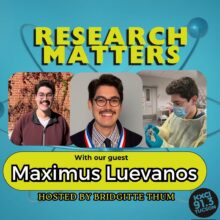


Maximus Luevanos is a Tucson, Arizona, native and Honors student at the University of Arizona, pursuing a Bachelor of Science in Neuroscience & Cognitive Science with a Neurobiology emphasis and a Bachelor of Arts in East Asian Studies with a Japanese Language emphasis, with an expected graduation in May 2027. His interest in pharmaceutical science is rooted in his experiences as a military child, his connection to the veteran community, and his own experience with PTSD. After experiencing severe seizure-like panic attacks, he had an emergency room visit and subsequent residential psychiatric treatment. This experience provided firsthand insight into the challenges of PTSD and the life-saving potential of medication, motivating him to pursue pharmaceutical research focused on developing safer treatments for anxiety and chronic pain.
At the University of Arizona, Maximus has developed extensive research experience in neuroscience and pharmacology. He previously worked in the Social Cognitive & Affective Neuroscience Lab, where he studied PTSD, its related health conditions, and published his first abstract. Since 2023, he has conducted research in Dr. Frank Porreca’s Medical Pharmacology Lab, investigating pain, migraine mechanisms, and addiction. His current honors thesis research examines a novel mu-opioid receptor antagonist compound in mouse models to evaluate its
potential to treat opioid overdoses while reducing adverse side effects.
Maximus has contributed to the University community as a Chemistry/Biochemistry preceptor and Thrive Center peer mentor. His service has also included tutoring, international student support, and volunteer projects benefiting the Tucson community and homeless veterans. He has received numerous honors, including the College of Science Neurobiology Scholarship, Freeman-ASIA Scholarship, All-Arizona Academic Team Scholarship, and Coca-Cola Academic Team Bronze Scholar Award.
After graduation, Maximus plans to pursue an M.S. in Medical Pharmacology at UA College of Medicine-Tucson and a Ph.D. in Pharmaceutical Science at Tokyo University of Science through the Japanese government’s MEXT scholarship, followed by a career in pharmaceutical research to develop safer, more effective treatments for patients affected by chronic pain and PTSD.
Transcript:
0:04: From KXCI Community Media, this is Research Matters.
0:06: My name is Bridgitte Thum, and I have the privilege of getting to speak with academic researchers from all over our region.
0:12: Today we are welcoming to the studio a senior from the University of Arizona who’s double majoring in neuro and cognitive science and Japanese with a minor in biochemistry.
0:23: Welcome to Research Matters, Maximus Luevanos.
0:25: Oh, thank you, thank you.
0:27: Nice, nice.
0:28: So tell me about your lab work.
0:29: You work in your labs?
0:30: I do, yes, my lab.
0:31: His name is the Frank Pereka Laboratory.
0:34: What kinds of things are happening in the lab?
0:37: Dr. Pereka’s lab focuses on neuroscience and pain, specifically chronic pain.
0:45: A lot of researchers at UA are always always trying to find alternatives to our current opioids that are very addictive.
0:53: You were testing out new things that people had created.
0:57: Yes, so currently my project is testing the mu opioid receptor antagonist, right?
1:04: It’s like an inhibitor of the mu opioid receptor.
1:07: So this new compound was designed to be an alternative or like a better version of naloxone because the problem is naloxone works great at saving the person’s life in the moment, but the side effects of naloxone are very not fun.
1:23: It kind of leads the person to quickly go back to using the drug that they’re addicted to.
1:27: These side effects are like diarrhea, vomiting, nausea, dizziness, like they, they don’t really feel good.
1:35: The idea is to find something that is less aggressive in the side effects.
1:40: Yes, that’s what my project is about.
1:42: So we get the mice addicted to morphine so that then we can compare the withdrawal symptoms that they feel after being administered naloxone and after being administered this new compound.
1:54: Can you explain to us why this research matters.
1:57: Yes, yes.
1:58: Unfortunately, a lot of people do get addicted to not just fentanyl, but other strong opioid compounds.
2:05: We can help someone break the cycle of addiction and then for me I’d say there’s a personal reason why I am interested in this field of research.
2:14: My dad was in the Navy for 20 years.
2:16: I learned kind of early on about soldiers with PTSD and depression.
2:21: Some soldiers and veterans, you know, do take their lives from that mental pain and everything.
2:27: And so ways they cope with it is either through alcohol addiction
2:30: or other types of controlled substances.
2:33: Even though I’m pursuing a research career now, I originally wanted to be a psychiatrist to help military veterans, but I discovered my true passion and interest was I’d say it was in research.
2:46: That’s why I do what I do here and why I say I think this matters because in my mind, although not all people who suffer from substance abuse are veterans, you know, those who are the people I’d like to help through this research.
2:59: You’ve been listening to Research Matters.
3:01: Our guest today is Maximus Luevanos from the University of Arizona.
3:06: Thank you so much for taking the time to come and tell us about your research, Maximus.
3:10: And thank you so much for having me here and giving me a platform to talk about my research.