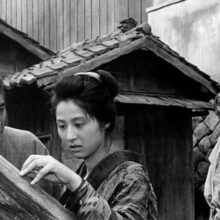




Nobuhiko Ôbayashi’s final film is a metafictional journey through the world of Japanese war movies, and their relationship to the actual horrors of war.
Nobuhiko Ôbayashi is famous in the West mainly for his film House, from 1977, which so far I know only by reputation as a wild, playful, and surrealist ride through the horror genre. But he’s directed over seventy films that are largely considered eccentric and avant-garde. I started watching his final film, from 2019, Labyrinth of Cinema without realizing any of this, purely on word of mouth.
Labyrinth of Cinema begins with a mysterious old hipster in shades, played by Yukihiro Takahashi, talking to us from the bridge of a spaceship/time machine that also seems to double as a fish bowl. After a roundabout explanation of what we’re about to experience, he lands in the present and goes to a cinema near the ocean that is showing one last movie, a war film, before closing its doors. Among the audience members are three young men who take the opportunity to enter, actually jump into, the film they’re watching. Their mission is to find out what war actually is, since their generation hasn’t been through one.
But this movie is not one single coherent narrative—it morphs into multiple stories that sample different historical war genres: samurai films, shogunate-era dramas, and of course World War II movies. Ôbayashi also includes teasing visual references to other classic Japanese cinematic themes and styles: yakuza flicks, “doomed romance” films, moody family and social dramas. The history of Japanese cinema is exhaustively lampooned, from the silent era to the postwar movies that broke through to the wider world.
The three young men are self-aware within the film—they know it’s a movie, and they remember things about the future that the people in the period films don’t know. But it becomes a thorny question in their minds as well whether they can actually be killed in the plots. While running through heavy gunfire, they joke about how the bullets don’t hit the main characters in films.
Ôbayashi merges his own footage with archival film, CGI on green screen, artificial sets, props, and backgrounds, as well as different colored iris effects, frames-within-frames, intertitles within framed borders onscreen, people narrating the film as in the silent era “benshi” tradition, alternating color with black & white, and most of all a rapid editing style that constantly keeps us off balance.
It’s often very funny, and quite heartless in its mockery of dramatic sentimentality and clichés. But the film is also so frenetic that it seems like a satire on the modern audience’s short attention span. The film’s first half is a riot of cartoon-like dark comedy. But gradually, the exaggeration in the way movies depict war is slowly and steadily tempered with the reality of war’s actual horrors. It’s not that the film is ever realistic. But the artificiality of cinema, consciously expressed and displayed, ends up heightening our consciousness of the real difference between fantasy and history, and it feels like a gut punch.
Ôbayashi was being treated for lung cancer throughout the shoot. The film was released in November of 2019. He died six months later. Labyrinth of Cinema was his strange and beautiful “swan song.”