


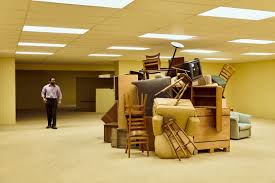
A man discovers a vast network of empty rooms and hallways, in a film about the dangers of the unconscious.
I just watched a weird and genuinely creepy film, currently getting a lot of attention, called Backrooms. One of the unusual aspects of this movie is that the plot, such at is, is secondary to the visual and auditory experience.
A disorienting opening sequence takes the fuzzy point of view of a video camera being used by an unnamed traveler in a series of nondescript, mostly empty rooms. Why this traveler is there we don’t know, but he wants out, and there’s a sense of something awful in pursuit.
Then, in the main part of the film—we’re told the year is 1990—we meet Clark, played by Chiwetel Ejiofor, the owner of a cheesy pirate-themed furniture show room in southern California. He’s meeting with his therapist named Mary, played by Norwegian actress Renate Reinsve, who sports a pretty good American accent for the role. Clark’s wife has recently kicked him out of the house. He’s angry, but suppresses his feelings. Mary puts him through a role-playing exercise where he goes through the conversation with his wife that precipitated the split, and he’s able to express his rage.
It turns out that Mary is a fairly well-known writer of self-help books in which she claims to offer readers a way to break through repetitive patterns of behavior and emotion, and forge a new path to the kind of life they would prefer. There’s something a little humorous about her seemingly unbreakable calm and her belief that anything can be worked through if you just talk about it.
The collapse of Clark’s marriage finds him living and sleeping overnight in the store. Strange periodic power outages at night cause him to go to downstairs to try to work on the fuse box. There he accidentally finds a seemingly solid section of the wall that is not solid, and he walks through it. On the other side he finds the vast network of empty rooms we glimpsed in the beginning of the film. In some of the rooms furniture is stacked up on the floor, others have piles of clothes or other items—nothing is functional. Clark hears a weird recorded voice in a foreign language and he follows the voice into a series of ever-more labyrinthian hallways and levels.
The young director, Kane Parsons, is fascinated by the concept of liminal spaces, locations that were once used and occupied, but that are now empty or dedicated to mere storage. The idea was floating around among horror fans, and in 2022, Parsons created a YouTube series about it also called Backrooms that went viral. For this feature film he brought in writer Will Soodik to produce a screenplay, and the result is astonishing. These abandoned places are not spooky castles or churches, but the ugliest and most banal rooms imaginable, lit by sickly fluorescent lights and evoking a feeling of dread just by their essential emptiness. There is a connection here to the feeling in nightmares, where places are dreamed that contain jumbled fragments of meaning and memory, and within which the dreamer struggles to get through to the outside.
Clark tells his therapist about this, and of course she doesn’t believe him. Then he stops coming, and Mary gets worried, deciding to go visit the furniture store to talk to him. She also discovers the backrooms. What happens does not conform to logic, but reflects the chaotic nature of the human unconscious and the destructive forces within.
Scary? Yes. But the real power of Backrooms lies in its ability to evoke a deeper and more profound sense of disquiet.