


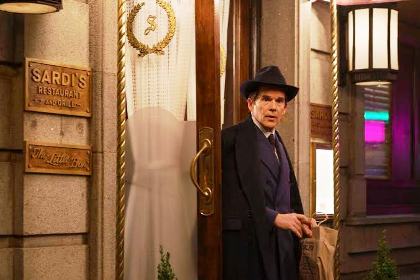
Depicts one night in the life of Broadway lyricist Lorenz Hart, when his partner Richard Rodgers premiers a new hit musical “Oklahoma!” done with a new lyricist, Oscar Hammerstein.
The Austin, Texas based director Richard Linklater is always trying new things. His latest movie is about the lyricist Lorenz Hart, who paired with composer Richard Rodgers to make 26 Broadway musicals in the 1920s, ‘30s, and ‘40s, featuring many songs that became classics, including “My Funny Valentine;” “The Lady is a Tramp; “Bewitched, Bothered and Bewildered,” and the one he’s made the title of the film: Blue Moon.
Blue Moon’s smart, witty screenplay is by the novelist Robert Kaplow, who based it on the letters of a young woman, Elizabeth Weiland, to Lorenz Hart during the last year of his life. Except for a brief opening scene, the story takes place during one night. We see Hart, known as Larry by his friends, in 1943 New York, attending the opening of the Broadway musical “Oklahoma!”. He quickly leaves the theater at the curtain call and goes to Sardi’s, the famous restaurant nearby, where the after party is scheduled. For those unfamiliar with musical theater history, the facts are laid out pretty clearly for you in the movie: Richard Rodgers had for the first time decided to work with a different lyricist on “Oklahoma!”, Oscar Hammerstein. Hart had turned that project down. It was a massive hit and led to a string of more hits with Hammerstein that remade the American musical. Talking to the bartender at Sardi’s, Hart makes clear that the kind of corny sentimental Americana represented by “Oklahoma!” was not for him. His lyrics always had a tinge of irony and humor and a clear-eyed sense of reality.
Hart is played by Linklater’s favorite actor, Ethan Hawke, and it’s an incredible, dominating performance. Hart, who is recently trying to stay sober, cracks jokes, confesses secret thoughts, and can’t conceal that he’s hurt by how things have turned out. This is like a stage play, not only because all the action takes place on this one night in this one location, but because the main character’s wonderful sinuous monologue is the constant thread of the film. Linklater has always made movies with lots of talking—it’s part of who he is—and Blue Moon is no exception.
When Rodgers, played by Andrew Scott, shows up with the triumphant company, Hart (who gave in and had a drink after all) can’t help but debase himself by pleading to do a show with him. Rodgers, who clearly loves his mentor, knows that Hart disapproves of his new direction with Hammerstein, and sees that unless Hart finds a way out of his alcoholism, they can’t work together anymore.
Throughout the evening, Hart raves about a young woman he has met named Elizabeth. Everyone, including the bartender played by Bobby Cannavale, knows that Hart is gay, but the man himself claims to be bisexual. Margaret Qualley arrives as the aspiring poet and set designer Elizabeth, who’s become Hart’s intimate friend. Hart thinks maybe they could be more than that.
If you’re unfamiliar with Ethan Hawke, you might not notice it, but he’s playing a character who is only five foot tall, almost a foot shorter then he. Linklater makes him look short without digital effects, just tricks of perspective and set design.
With its barbed humor about American culture, the exhausting nature of show business, and the tragic point when creativity runs dry, Blue Moon is a passionate and melancholy work. The song, as Hart tells us, was his least favorite, but in the end its sad refrain seems most fitting.