


Guillermo del Toro’s epic reimagining of the Mary Shelley novel is a marvel of Gothic style.
It was inevitable that Guillermo del Toro, with his love of fantasy, monsters, and everything Gothic, would create a version of Mary Shelley’s great novel Frankenstein. So of course he has, in a style of giant painterly excess that storms the heights of melodrama. What I’m saying is: it’s a thing of beauty.
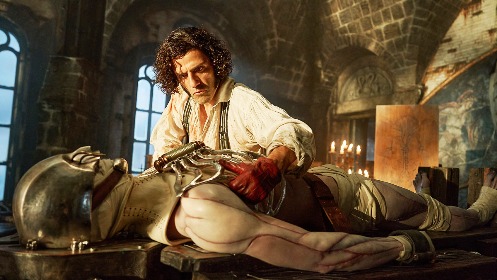
Del Toro is a director in the mold of classic Hollywood in its epic moods. He loves sets, props, costumes, and the craft of art direction. The film’s look boldly evokes early 19th century Gothic sensibility, detailed enough for historical accuracy, but expressed so dramatically as to make it all feel like a dream.
The film begins, like the novel, on an Arctic voyage, with a ship stuck in the ice, and the crew taking on board the half-dead Victor Frankenstein. Soon a terrible creature with superhuman strength attacks them, demanding one thing: that they give him Frankenstein or he will kill them all. This framing device leads to the mysterious man telling his story to the captain.
Del Toro, you should know, has his own vision of this tale, an interpretation that involves changing and adding situations, characters, motives and meanings from what they were in the book. Frankenstein’s childhood is marked by a cruel father and a young mother victimized until she died. His mother’s passing ignites his lifelong commitment to finding a way to defeat death.
The movie stars Oscar Isaac in the title role of the doctor and scientist possessed by his idea. He is well cast—Isaac has merged his personality into the Gothic melodrama style with a performance of utter conviction. Portraying the extreme emotional states of a man obsessed is always a delicate matter. It’s too easy to exaggerate, or to try projecting a dramatic presence that isn’t felt. There’s none of that here: actor and role seem perfectly one.
Victor’s creation of the monster, in a thrilling extended sequence, is one of the film’s most impressive achievements. But in this version, Frankenstein’s hubris is much more pronounced, and becomes pathological when he beholds the creature he has made. He only knows the desire to control. His attempts to teach his creation how to function as a living being are expressed only in power, threats, and violence. He refuses to see the monster as a sentient person, but only as an “it,” a thing. This, and not just the error of tampering with the order of nature, is his downfall—his own lack of humanity.
Del Toro’s greatest divergence from the usual focus of the Frankenstein myth concerns the creature. He is played by Jacob Elordi, and the wonderful makeup and special effects first emphasize the ghastly looks of a walking corpse. But as the movie goes on, we are made to perceive a certain kind of strange beauty in this creature. The film takes the side of the monster against those who fear him. This is about the rejected, the outcast, the strange outsider persecuted by a world that doesn’t understand and refuses to try.
The writing sags a bit in the last third, I think—it’s a long movie, almost three hours—but this is still a major work. It’s one of those films where you can give yourself up to the artistry and just let it carry you forward. Frankenstein takes us on a journey of profound emotional depth, to the limits of hatred and fear and also, amazingly, love and forgiveness.