


Considered a failure upon its release in 1984, David Lynch’s version of Frank Herbert’s novel already displays the bold absurdism that the director would take further in his later films.
I told someone the other day that I had seen all of the films by David Lynch. But later I realized that I’d forgotten Dune, from 1984, the one widely considered a failure. The completist in me decided I had to watch it. I’ve grown to like Lynch’s work, so it shouldn’t have been a surprise that I enjoyed Dune as well—but somehow it was.
Lynch took his chance to direct a big-budget science fiction spectacular that was based on a popular book. Evidently the producer, Dino De Laurentiis, was trying for another Star Wars (the original trilogy had just finished up in ’83), but if that’s the case, taking on the idiosyncratic Lynch as the director was a tactical error. Star Wars was simplistic good-and-evil derring-do aimed at the kids. Frank Herbert’s book was a more complicated kind of saga, and Lynch was attracted, I think, to the novel’s weirdness, it’s evocation of a completely alien world.
I have not read the book, or anything by Herbert. Here this counts as an advantage. I’ve learned that changes Lynch made to the story, especially its second half, were a turn-off for the book’s fan base. Without having read it, or ever planning to, I was open to what the film tried to do, rather than being sensitive to how it differed from its source.
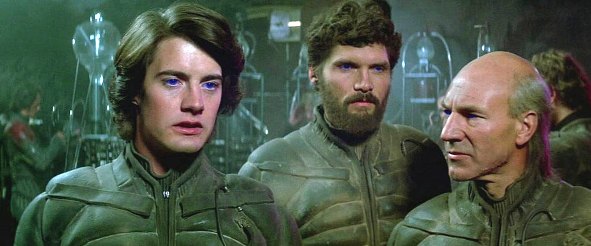
The marvelous special effects are of course analog, but defying the sleek and polished look of the space operas of that time. The ships feature massive pipes and vents, reminiscent of illustrations for Jules Verne, or to what would soon be labeled “steampunk” a few years later. The costumes, sets, and creatures are consistently odd, grotesque, amorphous. The plot, about two planets with two different royal “houses” fighting over a spice planet inhabited by giant worms and elusive indigenous people called “Fremen” (subtlety was apparently not one of Herbert’s strengths) is a feast of absurdity for an artist like Lynch, who revels in it while restraining the inevitable tendency towards “camp.” It’s all played straight, more or less, trusting the audience to accept all the weirdness as the status quo in this fictional dream.
It could be that my enjoyment was improved by having seen Lynch’s later work. Surreal visuals and irrational narrative devices are part of his style. At the time he had only done one midnight movie (Eraserhead) and The Elephant Man. People came to the film wanting and expecting a thrilling and coherent SF-fantasy story, but Dune was decidedly not that. Its pleasures are intense, but largely cerebral.
There are flaws. Putting the 24-year-old Kyle MacLachlan, someone who had never acted in a film before, at the center of a major production like this was a gamble. He does valiant work as Paul Atreides, the heir of one of the two houses, but he seems a bit out of his depth. Also, De Laurentiis subtracted about 40 minutes from Lynch’s cut, and the story is consequently harder to grasp. The general awkwardness, however, I think is actually part of the appeal. Dune feels unencumbered by conventional dramatic expectations. The music is by Toto and Brian Eno. The giant sand worms are unforgettable. All this underlines the neo-mythical nature of this world unlike any other. I find it fascinating, and amusing, to witness a major studio outer space epic transformed into a strange mad dream by a director who would then turn away from blockbusters and embark on even stranger journeys.