



Jia Jhangke uses footage spanning twenty years to present this portrait of the incredible changes that have taken place in China.
Jia Jhangke is, to my mind, the greatest living director in mainland China. His latest work, Caught by the Tides, actually seems to be a completely new kind of creation.
We begin in 2001, with candid footage of mostly middle aged women nostalgically sharing and singing traditional songs with each other, including some from Shanxi opera, in a large and plain-looking room. They are former opera singers having a twenty year reunion. The use of songs as a way to preserve our past cultural heritage is a theme that reappears throughout the film.
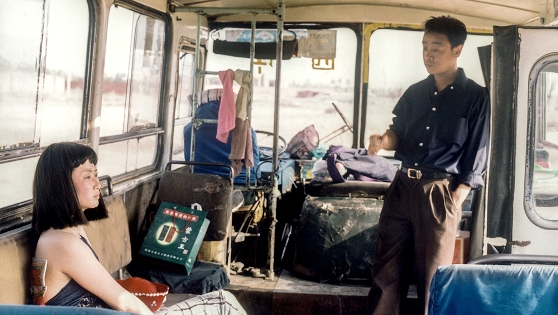
Is this is a non-fiction film, a documentary? It would seem so, as the movie continues with footage of people in the streets, ballrooms, shops, saloons, bus stations and so on—all working class people: talking, dancing, smoking. It’s a big, swirling picture of modern China, with no narration, presented mostly through visual means alone. We eventually discover that we’re in the northern mining town of Datong, where one young woman emerges as a character, Qiaoqiao, a dancer/escort at a bar.
In narrative film, characters normally exist against the background of the society they live in. In Caught by the Tides, however, the background is the foreground, and what fictional characters there are pop up occasionally within this foreground. You might not be sure at first that Qiaoqiao is fictional, but if you’ve watched Jia’s previous films you’ll recognize her as Zhao Tao, the director’s favorite actress who also happens to be his wife. Qiaoqiao is being kept, financially and otherwise, by a gangster-type fellow named Bin Guo, played by an actor who has appeared with Zhao in three of Jia’s films, Li Zhubin.
After he cruelly abandons Qiaoqiao, Bin goes, with the idea of making big money, to Fengjie in the south, where in 2006, the huge Three Gorges Dam project flooded towns and forced the displacement of thousands. He falls in with some pretty rough characters. Qiaoqiao eventually travels there too, repeatedly trying to contact him. Once again, the foreground is the setting itself, with breathtaking footage of the river, the dam, and the people. In one great wordless sequence with Qiaoqiao wandering near the water, we see old photographs among the rocks, snapshots of families that were forced to leave their homes—the music and the editing rhythm conveying the sorrow that words could not express.
At this point I noticed that Zhao’s face had aged—from the scared young woman’s appearance of 2001, to a more mature expression in 2006—but this is no trick of makeup. She has literally aged. Then I realized what Jia was doing. With the help of his co-screenwriter Wan Jiahuan, he used old footage from previous films featuring Zhao and Li, and from that constructed a new storyline in order to convey the passage of time and the startling changes that China has endured.
The final third of the movie is new footage shot recently, during the national crisis of the covid pandemic, with everyone in masks. The China we see now seems bewildering, almost alien. The grief and the determination to nevertheless move forward is palpable. In the final scene of Caught by the Tides, we (along with Qiaoqiao) re-enter the stream, affirming our value collectively and as individuals. Past and future remain connected.