


A Canadian family must cope with the mental illness of the eldest son.
When an artist attempts to illuminate painful memories, “less is more” is the general rule—one that is perhaps not followed frequently enough. Canadian director Sophy Romvari, after making award winning short films for ten years, adheres to that rule in her autobiographical first feature Blue Heron. Romvari was the youngest child in a family of four that moved from Hungary to Vancouver Island, British Columbia, in 1989. The family in Blue Heron is also of Hungarian origin. Although this element doesn’t seem crucial to the story, she evidently needed to include these specifics in order to more fruitfully draw on her memories.
We follow Sasha, an eight-year-old girl played by Eylul Guven, as she enjoys a beautiful summer on the island, exploring with her three older brothers, while her parents work to get accustomed to their new home in Canada. They try to start speaking English more. Father spends a lot of time working on the computer in some unspecified job, while Mother complains that she is left much of the time to manage the kids by herself. Romvari goes at a gentle pace. Aided by the fine cinematography of Maya Bankovic, she establishes a feeling for the rhythm of everyday life in this family, and the beautiful scenery of Vancouver Island.
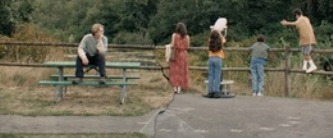
The movie begins with a brief voice-over narration by the adult Sasha, looking back and saying that it’s been hard to come to terms with her childhood because she was so angry at him. To whom is she referring? Only gradually do we find out. Her oldest brother Jeremy, who appears to be about 14 or 15, is having some problems. He often seems distant, acting disconnected with his parents and siblings. In an early sequence, while the rest of the family is walking through a nature preserve, he is sitting in the visitor center watching a park-produced video about the Canadian blue heron. Later, as they’re leaving, he shoplifts a little heron-shaped trinket from the gift shop.
The parents talk about Jeremy in private, not knowing what to do about his behavior. He often refuses to obey them, won’t talk, or stays in his room. He’s finally arrested for shoplifting something else, and Sasha sees him being brought home in handcuffs. Later a therapist says he shows signs of oppositional defiant disorder, which doesn’t give the parents much to go on in terms of how to deal with it. And eventually there comes some more self-destructive behavior that raises alarms.
Romvari’s intent is to discard the usual dramatic formulas about psychological problems. There are quite a few therapists and social workers in the film, and they’re respectful and helpful, but there’s a sense that the story remains largely mysterious, impenetrable by the suffering parents, with possible explanations concerning causes, but very little known about what can really be done.
The movie presents all this in the context of a little girl who feels loved in her family, especially by her mother, and—as in real life—not everything is bad. Romvari’s deceptively simple style creates an undramatic emphasis on the emotions of daily life.
Then the film takes a surprising and moving turn, as we find ourselves twenty years later with a grown up Sasha, visiting her childhood home like a social worker from the future, trying to come to terms with the slipperiness of memory and grief. Blue Heron is a profound reckoning with compassion.