



I’m fascinated by the films of Korean director Hong Sang-soo. In style, narrative, and intent, they seem unique. He has ideas to convey, but they’re always manifested through the semi-improvisatory dialogue and action of the actors. We see how people navigate their little worlds, and the quirks and subtleties of character they express, yet it all plays out undramatically, as part of the felt texture of everyday life.
Isabelle Huppert feels an affinity for Hong’s method. A Traveler’s Needs, Hong’s latest film, is the third time she’s worked with him. We first meet her character, Iris, talking to a young woman, played by Cho Yun-hee, in their shared language, English. Iris is teaching her how to speak French, but her technique is out of the ordinary. The student plays a short piece on piano, and then Iris asks her what she felt while playing. The young woman has clearly never talked about feelings this way, and it takes probing before she admits that she feels annoyed at herself for not being a better pianist. Iris asks more questions until, having heard enough, she writes a few sentences in French that summarize the student’s answers. The student is then supposed to recite these sentences as much as possible until she knows them by heart.
Behind the friendly yet tentative and sometimes awkward conversation, there is the odd effect of hearing two cultures trying to connect through a different medium: the English language. Most of the film is in English. The psychic effort people make in order to communicate with one another in a third language plays like a serious of thrusts and pauses in which the full characters of the people talking are never fully revealed.
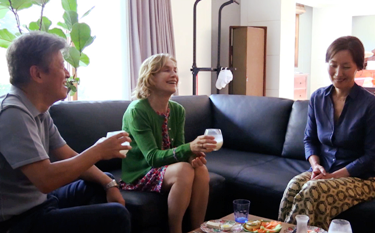
In the next scene, Iris meets a wealthy couple in their home, with the wife, played by Lee Hye-yeong (a regular in Hong’s films) trying to decide whether or not to take French lessons from her. Lee’s character is polite and seemingly very friendly, yet we feel a sense of calculated determination from her. In response to her questions, Iris reveals that she has only recently moved to Korea, has never taught French before, and has invented this new way of teaching the language that she “hopes” will work. This is understandably confusing for someone deciding if she should pay this woman for French lessons. It so happens that the wife plays a little song on a guitar, and then Iris uses the same method of questioning her about her feelings, and with the almost identical results. What looked like a spontaneous thing in the first scene is revealed here as a practice, and it’s funny.
There’s a lot more that happens in the last third or so of A Travelers’ Needs, involving a young man who’s agreed to let Iris rent a room in his house. The theme of people not saying directly what they mean becomes most pronounced here. It would be simple to see Iris’s easygoing temperament and lack of self-consciousness as a wonderful thing, but on the other hand, she seems to always be holding back. Hong is interested in how communication feels between the familiar (Korean family and society) and the unfamiliar (the eccentric French visitor).
The usual complaint about Hong’s films is that “nothing happens.” But as you watch, you may begin to ask yourself what you expect to happen, what you want to happen, why you’re expecting and wanting all this, and finally—what is it like to experience things without these filters, openly and directly.