



The story of a search for the body of a Vietnamese soldier killed during the war is set against the difficult lives of two young men working in a coal mine.
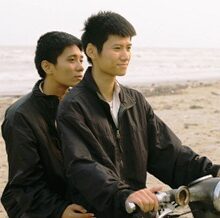
Việt and Nam, the second feature film from Vietnamese director Trương Minh Quý, begins with two young men working in a coal mine. The conditions are wretched, their bodies are black with coal, and—as we soon discover—they love each other. Much of the introductory section patiently lets us get to know these two in the customary darkness of their work environment. On a rare break, we see them eating while on a TV an announcer is going through a list of martyrs—men who died in the war—whose bodies were never recovered, then giving a helpline number for survivors. A casual conversation reveals that the story takes place in late 2001, when the long terrible war that had ended fewer than three decades earlier was still understandably an obsession with the Vietnamese public.
When the film first shows us scenes outside the mine, we get the impression of just brief intervals in between a prevalent darkness. They live in shacks near the forest—the older looking one, played by Pham Thanh Hải, living with his mother, who is determined to find the body of her husband, his father, gone missing somewhere in the south during the war. She has dreams that she believes give her clues as to the man’s fate and whereabouts. In a sign of acceptance that was perhaps unusual for the time, she encourages her son to bring along his friend, the younger looking man played by Đào Duy Bảo Định, to have dinner more often. She is clearly aware that they are lovers.
Although the English credits list these two characters as Việt and Nam, no one actually says their names in the film, and the original Vietnamese title means “underground,” so I’m inclined to think that the film’s English title is more allegorical than literal, as representing Vietnam and its historical situation through the ordeals of two men seeking to become one. “Underground” is more accurate, as the movie is all about the burial of the past and the emergence of the new from below against the background of the suffering symbolized by the coal mine.
Eventually they go on a journey south with the mother and an uncle, a veteran who served with the dead man. His stories about the horrific carnage of the war can freeze the heart. One of the few humorous moments is when he asks the young men when they’re getting married. “To each other?” asks his nephew. “No, silly, when you find the right girls.”
The trip south is filled with dark memories and premonitions. At one point they try to get the help of an unnerving woman psychic who specializes in finding war dead, painting her face white and screaming for the agony of lost soldiers. It’s all intended to provide closure, and the family goes along with it.
The film’s style opens up into a hushed vision of Vietnam’s landscapes. There’s no music until the end credits. Trương uses long takes and a meditative pace that focuses attention on the matter at hand: the weight of grief and death.
Pham’s character wants to leave the country for a better life; his partner refuses to come with him while insisting he can’t live without him. There’s a sense of entrapment, of no escape from overpowering sadness.
The government banned this film from being shown in Vietnam, not because of the gay sexual content—the country has become more tolerant in recent years—but because it depicts Vietnam as stuck in the past, a place of despair. Việt and Nam could be seen that way, but its central theme is of a love that never gives up.