



When considering the subject of a world in turmoil, and on the brink of disaster, we may want a film to give us temporary escape, or it might try to sublimate our pain and fear in order to invoke transcendence of some kind. But in some rare cases, a filmmaker will choose to face the crisis head on, with results that are always challenging. That’s the method Spanish director Óliver Laxe has chosen for his new film Sirât.
Sirât is an Arabic word for “path.” We’re in a desert where music is pulsing through huge speakers. It’s a dance party, a “rave,” with a sizeable crowd of young people dancing. One older man, Luis, played by Sergi López, walking through the crowd with his young son Esteban and a little dog, is asking everyone if they’ve seen his daughter, who he shows them in a photo. No one recognizes her.
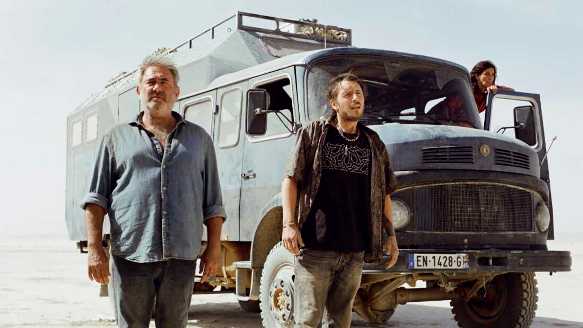
Suddenly some trucks with soldiers pull up, announcing that the rave will not be allowed to continue. In the long procession that follows the soldiers out, two vehicles, a big sturdy truck and a bus, head off the road and drive into the desert. Luis, behind them with his son in a minivan, thinks that these people must be headed to another rave, where maybe he could find his daughter, so he follows them. He has trouble navigating the terrain, and the people in the other vehicles try to discourage him from following them, but after he helps them pay for some gasoline along the way, they let him and Esteban come along.
Thus begins a long and torturous journey through the desert and into the mountains, where small dirt roads snake their way along the steep hillsides, and one small mistake could be fatal. In the truck and the bus are five people, three men and two women—a band of outcasts, people who have left home and have only each other for family. They’re tattooed, pierced, and weather beaten. One of them is missing a hand, another a leg. They seek new sensations, and we discover that they regularly ingest psychedelics as a tool for getting through their rugged lives. Luis and his son are gradually accepted into this group as they plunge ahead—but to where?
This tale, we find, takes place in Morocco, and the group is trying to reach Mauritania, on the coast of North Africa, but they become hopelessly lost. The electronic musical score by Kangding Ray is relentless, never letting up on the tension. On top of all this, in snatches of conversation, and bits of news on the radio, we also gather that there is some kind of world crisis happening, an escalating war of some kind. “Is this the end of the world?” someone asks. “It’s been the end of the world for a long time,” says another.
Sirât, gesturing towards apocalypse, is also about something more immediate: sudden death. In fiction and film, death has its foreshadowing, its drama, its last words. In truth, Laxe is saying, death has no such coherence, and it can grab us without any warning, leaving a chasm of unspeakable grief with the stupid finality of our loss. This magnifies an already stressful tale of a journey to nowhere into a sometimes excruciating encounter with our mortality. It’s a lot to ask of an audience, but this film refuses to make any bargains with reality. So, whose path is this? In the last scene, the devastating meaning of Sirât is finally revealed.