
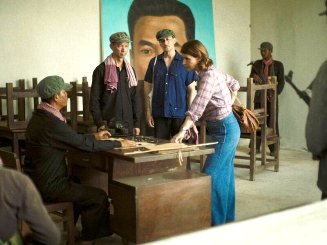
Cambodian director Rithy Panh dramatizes the true story of three journalists who were given permission to interview Pol Pot during the last few months of his murderous regime.
At the age of fifteen Rithy Panh managed to escape the Cambodian genocide, but the entire rest of his family—his parents, sisters, and nephews—were murdered. He made his way to Paris, where he got interested in movies, and eventually graduated from film school there. His career as a director has been devoted almost exclusively to examining that terrible period when the Khmer Rouge conducted mass executions of anyone labeled as bourgeois or intellectual. Combined with the exhaustion, starvation and lack of medical care in the camps, the result was roughly a quarter of the population, over 2 million people, dying between 1975 and ’79. Panh made over a dozen films about various aspects of the genocide before his international breakthrough, The Missing Picture, in 2013. In The Missing Picture, because photographic evidence was so sparse, he used clay figurines in still shots to depict the plight of victims in the death camps, based on written testimony from survivors, and surprisingly, it proved to be a potent technique. Five films and eleven years later, he’s created another important work called Meeting with Pol Pot.
Pol Pot was of course the leader of the Khmer Rouge, the brutal ruling party in Cambodia. The film is based on a real incident in which two American journalists, along with a Marxist academic from Scotland who knew Pol Pot and believed in his cause, were given permission to interview him in 1978, shortly before the invasion by Vietnam that eventually defeated the regime. The story is based largely on a book by one of the journalists, Elizabeth Becker. However, Panh has fictionalized the events somewhat to emphasize the discovery of the monstrous truth by observers from the world outside Cambodia. The three principals have been made French, and are played by Irène Jacob, Cyril Gueï, and Grégoire Colin; I’m guessing because Panh has always been based professionally in Paris, has a French co-screenwriter (Pierre-Erwan Guillaume) and French financial backing. In any case, the movie sticks to most of the facts, as well as the shocking outcome, of the true story.
The film creates a steadily mounting sense of dread, largely because the three journalists don’t know any of the facts that we now know about the killing fields. And even though we know the basic outlines, the extent of the evil that slowly becomes apparent has a shocking effect. It’s scary to imagine being in their situation, supposedly privileged to get an interview with Pol Pot, which would be a real scoop, but feeling unavoidably threatened by the menace of what the people in charge are capable of doing. The journalists are confined to a couple of houses with cots while the Khmer Rouge officials keep delaying the promised interview due to supposed scheduling conflicts.
At times, Panh returns to his method of using clay figurines to depict the dehumanizing aspects of the story. Gueï’s character, a photographer, is the first to suspect the version of reality that their hosts are presenting, and against orders he goes off the grounds to look around the surrounding country, which gets them in trouble. Colin is excellent as the overconfident Marxist correspondent who resists acknowledging the horror. Jacob’s character is the courageous moral center of the film, sticking to principles despite the fear that threatens to consume her. Meeting with Pol Pot is a gripping and revelatory experience.