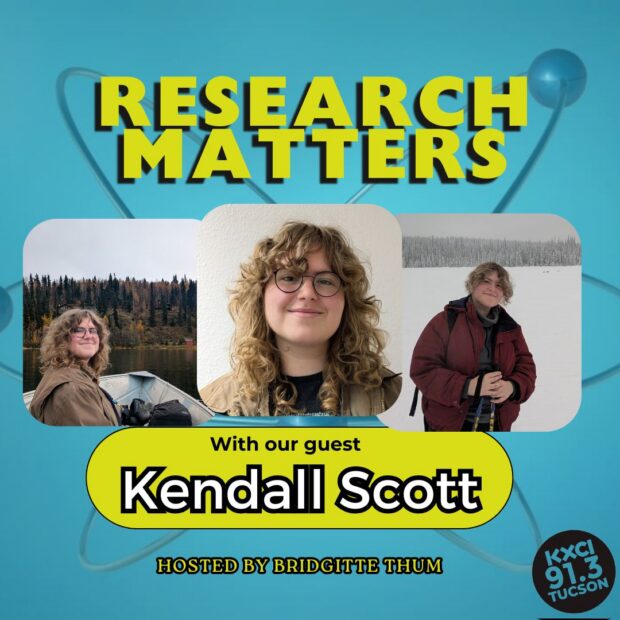
Kendall Scott is a born and raised Tucsonan and a student at the University of Alaska Fairbanks. She splits her time between Arizona and Alaska, enjoying the best and worst of the extreme climates. She enjoys writing and editing, and is pursuing a degree in psychology. In her free time, Kendall enjoys music, acoustic guitar, and digital art.
transcript:
0:04: From KXCI Community Media, this is Research Matters.
0:07: My name is Bridgitte Thum, and I’m so grateful to be able to sit and chat with academic researchers from all around our region.
0:14: Joined in the studio right now with a former youth broadcaster from KXCI’s youth broadcasting program, Kendall Scott, who is researching zooplankton on a cruise.
0:27: Tell us all about it, Kendall.
0:28: So I’m a student at the University of Alaska Fairbanks.
0:31: I’m actually a psychology major and a journalism minor, but I got the opportunity to volunteer on board the research vessel Sally Ride on the northern Gulf of Alaska spring cruise.
0:43: This is a long-term ecological research project, meaning it’s been going on for at least a decade.
0:49: They’ve been collecting this data repeatedly in the spring and fall most years.
0:53: The research vessel Sally Ride is coming up from California and parking in Seward, Alaska, which is in South Central Alaska.
1:01: And it’s going to be a 20-day cruise going about 200 something miles offshore.
1:06: And there are about 20 researchers on board the boat, all doing different disciplines.
1:11: So, we have people doing zooplankton research like I am.
1:15: We have some people doing ecological and environmental atmospheric research, bird research, and, you know, Nutrients, oceanography, physics.
1:26: So it’s kind of a multidisciplinary crew.
1:28: Doesn’t this sound like fun?
1:29: I’m very excited.
1:31: Tell us about the plankton.
1:32: What are you looking at?
1:33: What are you looking for?
1:35: I’m looking at various species of zooplankton.
1:37: There are thousands of species.
1:39: The ocean has two major groups of like microscopic and smaller organisms, phytoplankton and zooplankton.
1:45: Phytoplankton are eukaryotics.
1:47: They’re photosynthetic and the zooplankton are like animal organisms, basically.
1:52: And my role is doing zooplankton collection.
1:56: So, we get what’s called like a multi-net.
1:57: It’s a multi-tiered net that has different grains of mesh that when we bring in the zooplankton, the smaller ones can all get in the same section, you know, increasingly larger, like a really teeny tiny coin separator.
2:11: Yeah, exactly.
2:13: I also, because I’m working night shift, zooplankton do this thing called diurnal migration, where they go closer to the surface at night.
2:20: So, that’s why we collect at night.
2:22: I will be able to just kind of hang out in the evening before my shift.
2:26: I’m working like 9:00 p.m. to 7 a.m. is my, my shift on deck, but I’ll be able To see what research is happening during the day and my, their dinner will be my breakfast, you know, so I’ll get to have time, especially when we’re in transit, talking to other researchers, you know, I’m especially interested in the seabirds research and seeing what they’re doing because I, I love bird watching.
2:45: So, I’m planning to bring some binoculars and enjoy that.
2:49: Bird watching is everything right now.
2:51: It is the rage.
2:52: Yeah.
2:53: Kendall, what do you think the practical application is for all this research happening on this ship?
2:57: A lot of this research is looking at how oceans are impacted by a changing climate.
3:01: Getting long term ecological research like this helps us to see change over decades, over time, which is really important to see.
3:09: How these environments are changing, what the species are doing in response to warming temperatures, and also the current seasonal conditions of the ocean that they’re in.
3:20: My research specifically will probably be analyzing numbers of zooplankton as well as how they’re behaving, how many we’re seeing, where we’re seeing them.
3:29: And then that’ll go on to be processed by the actual chief scientists and people who are publishing research about this.
3:37: You’re listening to Research Matters on KXCI Tucson.
3:40: We’ve been speaking with Kendall Scott.
3:42: Best wishes to you.
3:44: It’s been wonderful having you in the studio today.
3:46: Thank you so much for being here, Kendall.
3:48: Thank you for having me.
3:49: I appreciate it.
3:51: Research Matters is made possible thanks to support from listeners just like you.
3:56: Here at KXCI Tucson, we are in the midst of our spring drive, and it would be a wonderful thing to show your support for independent community media just like this today at KXCI.org and thank you.
______________________
Research Matters is recorded, edited, hosted and produced by Bridgitte Thum KXCI’s Production Manager