

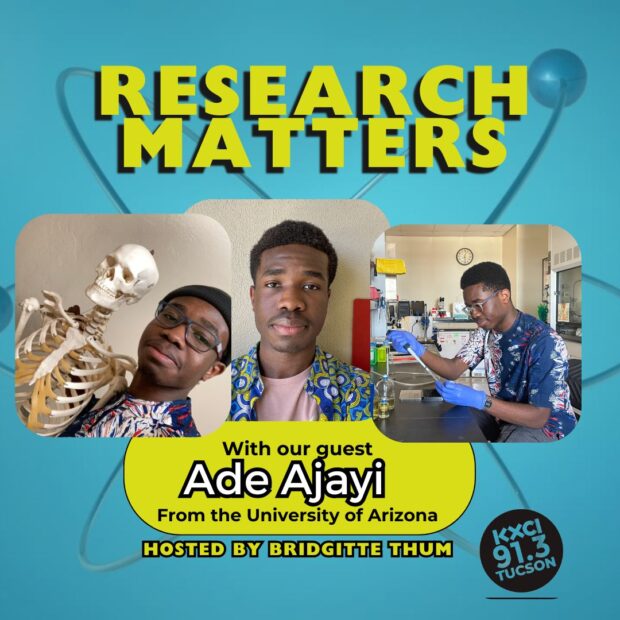
Hello. My name is Adeoluwa Ajayi, and I am a senior studying Molecular and Cellular Biology at the University of Arizona. I was born and raised in Lagos, Nigeria. I am currently completing my Honors Thesis in the Riedel- Kruse Lab; my research comprises the expansion of our synthetic microbial toolbox with novel fluorescent “building blocks”. This is part of our lab’s greater goal of developing compatible synthetic biology components for use in high-level, applicable multicellular systems. After graduating, I would like to complete a doctorate. Outside of the lab, I enjoy watching motor racing and association football, discussing etymology, and taking photos.
Transcript:
0:08: From KXCI Tucson, this is Research Matters.
0:10: My name is Bridgtte Thum, and I’m happy to be able to sit and talk with academic researchers from around our region about what they’re working on.
0:19: Today we’re welcoming to the studio a senior who’s majoring in molecular and cellular biology.
0:24: Welcome to Research Matters.
0:26: Ade Ajayi.
0:27: That’s me.
0:28: How’s it going?
0:29: Good.
0:29: Ade.
0:30: Tell me about the lab you’re working in.
0:32: I work in the Riedel- Kruse lab, and we are a synthetic biology lab where we study microorganisms.
0:37: Microorganisms are capable of doing really big things, aren’t they?
0:41: Yes, they are.
0:42: Sometimes microorganisms, including bacteria and including E.
0:45: coli, assemble into biofilms.
0:48: What’s a biofilm?
0:50: Bacteria like E.
0:51: coli are usually single-celled, while that is useful for them in their survival, sometimes for applications that are useful to human beings, like creating new chemicals, for example.
1:04: We need them to function as a team.
1:06: How do you get the bacteria to work together as a team?
1:10: So one of the concepts that’s been developed in our lab is synthetic adhesions, little sticky bits expressed on the surface of the bacteria that stick to one another and hold the two different cells in place.
1:24: So this is useful for us because we’re controlling it.
1:28: You’re essentially building a cohort out of this biofilm community.
1:31: Exactly, like, biofilms are also called synthetic cohorts, synthetic consortiums.
1:36: The DNA we want them to have is available to them, and there’s usually no pressure for them to take up that DNA, but if you make it such that they need that little circle of DNA to survive, and they take it up happily because they need it for the food.
1:52: To modify these plasmids, we have to be able to cut them, and for that we use proteases.
1:59: We have to be able to put them back together for that we use ligases.
2:02: We have to be Able to produce lots of the tiny bit I want to insert.
2:08: For that we use PCRs.
2:10: What’s a PCR?
2:11: It’s a polymerase chain reaction, so it’s where you have a stretch of DNA and you want to produce a lot of stretches of that DNA.
2:22: So, yeah, it’s a copy machine, yeah, it’s a photocopier.
2:25: DNA is really complex, so I make like I make a little plan of what I hope to do, what I hope to cut out, what I hope to put in, and the final finished product.
2:34: And I hope that when I put it all together, it works.
2:38: So if you can learn to manipulate DNA, you can do huge things in this world.
2:44: It’s a great hope that we could create consortia, biofilms that are very useful for cleaning up sewage and spills, and all of the things that it could be useful for that we haven’t even discovered yet.
2:55: Yes.
2:56: You are listening to Research Matters.
2:58: Our guest today has been molecular biologist Ade Ajayi.
3:04: Thank you so much for coming.
3:05: Thank you for having me.
3:07: You’ve been listening to Research Matters from KXCI Tucson.
3:12: To hear more episodes or for more information, visit the program’s page at KXCI.org.